
Generative AI vs Predictive AI: 7 Vital Insights Creating the Future
Generative ai vs predictive ai is the single most important debate defining the technological landscape of this decade. Look, I’ve spent years analyzing enterprise tech stacks, and the confusion between these two powerhouses is stalling progress. Most leaders think AI is a monolith. It isn’t. You have one engine built for creation and another built for calculation. Mixing them up isn’t just a syntax error; it’s a strategic disaster that costs millions.
We are seeing a massive shift. While organizations rush to implement the latest LLMs, they often overlook the quiet, analytical power of predictive models that have been driving profits for years. The truth is, understanding the nuance of generative ai vs predictive ai isn’t just academic—it’s the difference between a stalled pilot project and a market-dominating product. In this deep dive, I’m going to break down exactly how these technologies differ, why the distinction matters for your bottom line, and how to leverage both to dominate your sector.
Table of Contents
- 1. Defining the Core: Generative AI vs Predictive AI Capabilities
- 2. Under the Hood: Technical Architecture of Generative AI vs Predictive AI
- 3. The Fuel: Data Requirements for Generative AI vs Predictive AI
- 4. Strategic Use Cases: When to Deploy Generative AI vs Predictive AI
- 5. Economic Impact: The Market Value of Generative AI vs Predictive AI
- 6. Risk Management: Hallucinations in Generative AI vs Predictive AI Bias
- 7. The Hybrid Edge: Merging Generative AI vs Predictive AI
1. Defining the Core: Generative AI vs Predictive AI Capabilities
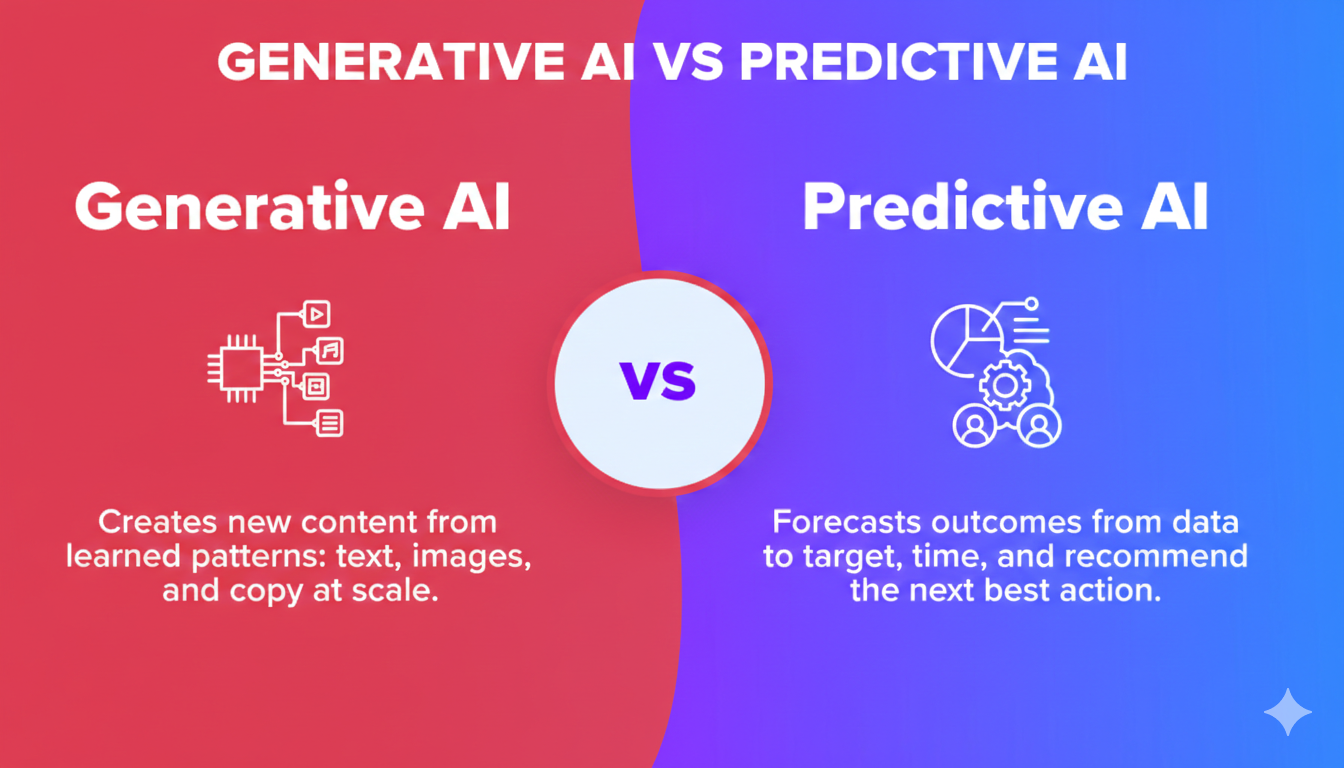
Let’s cut through the noise immediately. When we talk about generative ai vs predictive ai, we are fundamentally talking about the difference between imagination and anticipation. Generative AI (GenAI) is the artist and the author. It creates new digital assets. Whether it is a block of Python code, a marketing email, or a synthetic image, the output is something that didn’t exist before. It learns patterns to produce novelty. It is designed for creation and innovation.
On the flip side, Predictive AI (PAI) is the actuary and the analyst. It doesn’t create new content; it generates answers. It looks at historical data to forecast a future event or classify a current state. It outputs a probability, not a poem. As noted by experts at IBM, the primary distinction lies in the output: GenAI produces a digital asset, while PAI produces a forecast. This is a critical distinction.
I’ve seen too many CTOs try to use GenAI for forecasting. It fails. Why? Because GenAI is probabilistic in a way that prioritizes plausibility over accuracy. It wants to complete the sentence, not solve the equation. Predictive AI, however, is laser-focused on accuracy. It minimizes error rates in numerical projections. If you are trying to guess next quarter’s revenue, you don’t want a creative answer. You want a precise one. Understanding this core function of generative ai vs predictive ai is step one in building a competent strategy.
2. Under the Hood: Technical Architecture of Generative AI vs Predictive AI
To really grasp the divergence, we have to look under the hood. The architectures powering generative ai vs predictive ai are as different as a jet engine and a battery. Generative AI typically relies on massive Transformer models (like LLMs), Generative Adversarial Networks (GANs), or Diffusion models. These architectures are designed to understand context and relationships within vast, often unstructured datasets. They predict the next token in a sequence. They are asking, “Based on all the text I’ve seen, what word likely comes next?”
Predictive AI operates differently. It utilizes statistical models, regression analysis, decision trees, and clustering algorithms. These are mathematical structures designed to draw a line through data points and project where that line goes next. They predict the future occurrence of an event. While GenAI is often a “black box” with high complexity and lower explainability, Predictive AI can often be more transparent. You can trace the logic.
From my experience, the computational cost is also a major differentiator. Training a GenAI model requires enormous GPU clusters and energy—it’s expensive. Predictive models can often run on lighter infrastructure, especially once trained. When you are budgeting for generative ai vs predictive ai, you aren’t just comparing software; you’re comparing entirely different infrastructure requirements. Ignoring this technical reality is why so many AI budgets blow up before the project even hits production.
3. The Fuel: Data Requirements for Generative AI vs Predictive AI
Data is the oxygen for these systems, but they breathe different air. The data requirements for generative ai vs predictive ai dictate how you prepare your organization. Generative AI creates value from massive, unstructured datasets. We are talking about the entire internet’s worth of text, libraries of video, and terabytes of audio. It thrives on messiness because it learns the hidden patterns of human expression within that mess. It needs volume—colossal volume.
Predictive AI is pickier. It craves structure. It needs clean, historical, labeled data. If you feed a predictive model messy, unstructured garbage, you get garbage predictions. It relies on specific rows and columns: transaction logs, sensor readings, customer churn rates. The integrity of this data is paramount. As Coursera research highlights, PAI is designed for accuracy and anticipation based on targeted inputs.
Here is the strategic implication: If your data is locked in PDFs and emails, GenAI can unlock it. If your data is neatly organized in SQL databases, PAI is ready to mine it for gold. Many companies fail because they try to force a predictive model to understand unstructured text without preprocessing, or they expect a GenAI model to give precise financial forecasts from a spreadsheet. Aligning your data readiness with the specific needs of generative ai vs predictive ai is the only way to ensure your pilot doesn’t join the 80% of AI initiatives that stall.
4. Strategic Use Cases: When to Deploy Generative AI vs Predictive AI
Nicholas Renotte, a Chief AI Engineer at IBM, put it best: “Picking the right use case is the most critical step.” The battle of generative ai vs predictive ai is won or lost here. Let’s look at GenAI. Its sweet spot is augmentation and automation of creative tasks. In software development, tools like GitHub Copilot are automating code generation. In customer service, we have moved beyond robotic scripts to human-like chatbots that can handle complex queries. In healthcare, it is accelerating drug discovery by proposing new molecular structures that never existed before.
Now, look at Predictive AI. It dominates in high-stakes decision-making. In finance, it is the backbone of fraud detection, analyzing millions of transactions in real-time to flag anomalies. In supply chain logistics, it optimizes inventory by predicting exactly when a consumer in Ohio will want a winter coat. In manufacturing, predictive maintenance algorithms analyze sound and vibration to tell you a machine will break before it actually does.
The mistake I see? Using the wrong tool. A marketing team might use PAI to analyze customer segments (good) but then fail to use GenAI to personalize the content for those segments (bad). Or a CFO might try to use a GenAI chatbot to predict next year’s stock price (disastrous). You must map the capability to the problem. If you need a new thing, use GenAI. If you need to know what will happen next, use PAI. Mastering the application of generative ai vs predictive ai requires this level of disciplinary discipline.
5. Economic Impact: The Market Value of Generative AI vs Predictive AI
Let’s talk numbers. The economic footprint of these technologies is staggering, but the growth curves tell an interesting story. The global GenAI market alone is projected to hit roughly $55.51 billion by 2026, with long-term forecasts from Bloomberg and Precedence Research suggesting a surge to a massive $1.3 trillion by 2032. This isn’t just hype; it represents a fundamental restructuring of how work gets done. Adoption rates are climbing fast—Stanford HAI reports that 78% of organizations used AI in 2024, up from 55% just a year prior.
However, the value realization in generative ai vs predictive ai differs. PAI has been delivering ROI for decades. It’s entrenched in banking, insurance, and heavy industry. The ROI is calculated in risk avoided and efficiency gained. GenAI is the newcomer, driving value through productivity uplifts and novel product creation. The salaries reflect this demand; AI engineers capable of navigating both domains are commanding median total compensation north of $140,000.
But here is the warning label: massive investment does not guarantee massive returns. With 80% of initiatives stalling, money is being incinerated on bad strategy. Companies are buying expensive GenAI compute for problems that a simple regression model could solve. To capture a slice of that $1.3 trillion pie, you need to stop chasing the buzzwords and start calculating the unit economics of your specific implementation of generative ai vs predictive ai.
6. Risk Management: Hallucinations in Generative AI vs Predictive AI Bias
Every powerful tool has a safety catch, and AI is no exception. The risks associated with generative ai vs predictive ai are distinct and dangerous in their own ways. Generative AI is infamous for “hallucinations.” Because it is probabilistic, it can confidently state facts that are completely fabricated. I’ve seen legal briefs cited by GenAI that refer to cases that never happened. In a business context, this can lead to reputational suicide if not kept in check by a human-in-the-loop.
Predictive AI has a different demon: Bias. PAI is only as good as the historical data it feeds on. If your hiring data from the last ten years favored men over women, your predictive model will “accurately” predict that men are better candidates. It propagates past prejudices into the future. It’s not hallucinating; it’s amplifying a flawed reality. This is often harder to detect than a hallucination because the math looks correct.
Mitigating these risks requires different protocols. For GenAI, you need rigorous fact-checking layers and constraint systems (RAG). For PAI, you need algorithmic auditing and diverse training datasets. You cannot treat the risk profile of generative ai vs predictive ai as identical. One lies to you; the other misleads you based on your own bad history. Understanding which poison you are dealing with is essential for the antidote.
7. The Hybrid Edge: Merging Generative AI vs Predictive AI
Here is the bottom line: The future isn’t binary. It’s not about choosing generative ai vs predictive ai; it’s about fusing them. The true “Strategic Edge” comes from the synergy. Imagine a cybersecurity system. The Predictive AI analyzes network traffic to flag a likely breach (anticipation). Instantly, the Generative AI writes a patch script to close the vulnerability and drafts an incident report for the C-suite (creation). That is the holy grail.
We are seeing this in marketing too. Predictive AI identifies a surging micro-trend among Gen Z consumers next week. Generative AI then instantly produces thousands of personalized ad variations targeting that specific trend. This loop—foresee then create—reduces the time-to-action from weeks to milliseconds. It turns insight into asset instantly. This is where the market winners will be separated from the losers.
Experts agree that these technologies are not mutually exclusive. They are complementary forces. PAI provides the direction; GenAI provides the vehicle. If you are siloing your data science teams into “predictive” and “generative” camps, you are doing it wrong. Break down the walls. The most potent applications of the next five years will be the ones that seamlessly integrate the analytical precision of predictive models with the creative power of generative engines. The debate of generative ai vs predictive ai should end in a handshake, not a fistfight.
Conclusion
The landscape of generative ai vs predictive ai is evolving rapidly, but the fundamentals remain clear. One creates the future; the other foresees it. Generative AI offers us the power of infinite creation, automating the labor of thought and art. Predictive AI offers us the power of foresight, mitigating risk and optimizing our path forward. The error is in thinking you have to choose.
Your strategy for 2025 and beyond must be inclusive. It must leverage the statistical rigour of predictive models to identify where to go, and the creative engine of generative models to build the assets you need to get there. Don’t get lost in the hype. Focus on the output: Do you need an answer, or do you need an asset? Answer that, and you solve the puzzle. The organizations that master the interplay of generative ai vs predictive ai will not just survive the coming shift—they will dictate it.
Watch Videos
Frequently Asked Questions
What is the main difference between generative AI and predictive AI?
The main difference lies in their output. Generative AI creates new content (text, images, code) based on learned patterns, while Predictive AI analyzes historical data to forecast future outcomes or probabilities. Think of GenAI as a creator and Predictive AI as a forecaster.
Can generative AI replace predictive AI?
No, they serve different purposes. While GenAI can simulate some reasoning, it lacks the statistical precision of Predictive AI for tasks like financial forecasting or risk assessment. They are best used together rather than as replacements for one another.
Which is more expensive to implement, generative or predictive AI?
Generally, Generative AI is more expensive initially due to the massive computing power (GPUs) required for training and running large language models. Predictive AI often runs on more standard infrastructure, though costs vary based on data complexity.
How are generative AI and predictive AI used together?
They are often used in a “predict-then-create” loop. For example, Predictive AI might forecast a customer’s likelihood to churn, and Generative AI can then instantly create a personalized email offer to retain them. This combines accuracy with personalized action.
Is predictive AI considered legacy technology now?
Not at all. While GenAI is the current hype, Predictive AI remains the backbone of enterprise operations, driving critical decisions in finance, logistics, and healthcare. It is evolving alongside GenAI, not being replaced by it.